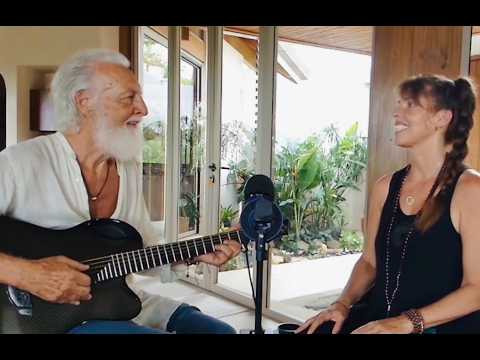
Deva Premal and Miten offer a live concert performance of the Gayatri Mantra, one of the most ancient and revered Sanskrit chants in Hindu spiritual tradition. The performance explores the mantra's essence through kirtan—sacred vocal repetition—demonstrating how the Gayatri functions not merely as words but as vibrational practice that bridges individual consciousness with universal energy. The concert emphasizes the mantra's role in awakening inner light and transforming the mind through the power of sacred sound.
What Is the Gayatri Mantra?
The Gayatri Mantra is one of the oldest and most respected mantras in Hindu and Vedic traditions, appearing in the Rigveda, the oldest of the four Vedas. The mantra invokes Savitr, the solar deity associated with illumination and awakening. In Sanskrit, the Gayatri addresses the life force of the sun and, by extension, the universal source of consciousness that sustains all existence. When chanted, it is understood not as a petition to an external god but as an invocation of the divine light already present within the self.
Deva Premal and Miten's live performance treats the Gayatri as a living practice rather than a historical artifact. By presenting it in concert form—with extended vocal repetition, harmonic layering, and meditative pacing—they translate an ancient text into a contemporary spiritual experience. The performance demonstrates that the mantra's power lies not in intellectual understanding but in sustained vocal engagement with its syllables and resonances.
How Does Sacred Sound Transform Consciousness?
In kirtan practice, the human voice becomes an instrument of transformation. Mantras like the Gayatri are not meant to be recited silently or passively; they are designed to be sung or chanted aloud, allowing the vibrations to move through the body and nervous system. Deva Premal and Miten's approach emphasizes this embodied dimension. As they repeat the mantra's syllables, they create a sonic field that invites listeners to enter a state of focused attention and inner stillness.
The repetitive structure of mantra chanting works on multiple levels. Physiologically, the rhythmic vocalization slows the breath and heart rate, engaging the parasympathetic nervous system. Psychologically, the repetition anchors the mind to a single point, interrupting the habitual chatter of discursive thought. Spiritually, the mantra's sacred syllables are understood to carry frequencies that attune consciousness to higher states of awareness. In this live setting, the kirtan becomes a collective experience—the audience's silent listening or soft joining amplifies the field created by the singers.
What Does the Gayatri Mantra Actually Mean?
The Gayatri Mantra reads in Sanskrit:
Om bhur bhuvah svah / tat savitur varenyam / bhargo devasya dhimahi / dhiyo yo nah prachodayat
A common translation is: "We meditate on the adorable glory of Savitur the Sun, the creator of all beings, who impels the universe. May he guide our intellect toward the path of enlightenment." However, word-for-word translation obscures the mantra's deeper function. Each syllable and phrase carries layers of meaning. "Bhur" refers to the physical plane; "bhuvah" to the subtle or mental plane; "svah" to the causal or blissful plane. Together, these open the meditation to all dimensions of existence.
The phrase "tat savitur varenyam" (the adorable light of Savitur) points not to the literal sun but to the inner light of consciousness. "Bhargo" (radiance or effulgence) suggests the illuminating power that dispels ignorance. The final request—"dhiyo yo nah prachodayat" (may he direct our intellect)—asks for the awakening of discriminative wisdom. In Deva Premal and Miten's performance, these meanings remain implicit; the focus is on the mantra as sound and vibration rather than as intellectual content.
Why Do Spiritual Teachers Like Deva Premal and Miten Teach Mantras in Concert Settings?
Concert performances of sacred chants serve multiple functions in contemporary spiritual practice. First, they make ancient traditions accessible to audiences who might not have formal training in Sanskrit or Hindu philosophy. A listener unfamiliar with the Gayatri's origins or meaning can still benefit from the vibrational field created by skilled singers. Second, the concert format creates a shared container for spiritual experience. Unlike individual practice, group kirtan generates a collective resonance that many practitioners report as more powerful and stabilizing than solitary chanting.
Deva Premal and Miten have become known for bringing mantras to global audiences precisely through this approach. Rather than treating sacred chants as museum pieces or historical curiosities, they sing them as living practice. The extended musical arrangements, the carefully constructed harmonies, and the meditative pacing all serve the mantra's function—to quiet the mind and attune it to subtler dimensions of consciousness. The audience's immersion in the sound becomes a form of meditation.
How Does the Gayatri Mantra Relate to Inner Light and Awakening?
The Gayatri invokes light—specifically, the light of Savitur, the sun god. But in Hindu spiritual philosophy, this outer light is always a symbol of inner illumination. The sun of consciousness that dwells in the heart is the same light invoked by the mantra. Regular chanting of the Gayatri is traditionally understood to awaken this inner light, removing the darkness of ignorance and confusion.
In meditative practice, this awakening is not purely metaphorical. Practitioners often report experiencing inner light, luminosity, or clarity after prolonged mantra chanting. These experiences are understood in yogic physiology as the activation of subtle energy channels and chakras—the energy centers aligned along the spine. The Gayatri, with its focus on the solar principle, is particularly associated with activation of the manipura (solar plexus) chakra, which governs personal will, transformation, and the capacity to burn through obstacles. Deva Premal and Miten's live performance, by sustaining the mantra over extended periods, creates conditions for such subtle shifts in consciousness.
What Is the Role of the Singer in Mantra Transmission?
In the kirtan tradition, the singer is not merely an entertainer but a transmitter of sacred vibration. Deva Premal and Miten approach their role with this understanding. Their vocal training, their deep familiarity with the mantra, and their own spiritual practice shape how they present the chant. The purity of their intention, the steadiness of their breath, and the clarity of their pronunciation all contribute to the quality of the field they create. A well-trained singer chanting a mantra with genuine spiritual commitment generates a different impact than casual recitation.
This is why guru-disciple relationships have traditionally been central to mantra practice. The mantra is not just a text to be read or even chanted mechanically; it is transmitted through a living relationship with someone who embodies its power. Deva Premal and Miten, through their concert practice and teaching, offer a contemporary form of this transmission. The listener's exposure to their refined chanting, even in a concert setting, is understood to transmit not just the mantra but the state of consciousness associated with skillful practice.
Where to Go From Here
For those new to the Gayatri Mantra, listening to skilled practitioners like Deva Premal and Miten is an excellent entry point. The performance available on their YouTube channel offers a gateway into deeper engagement with the mantra. From there, a natural progression involves establishing a personal practice—chanting the Gayatri daily, either aloud or silently, traditionally at dawn or at the transition times of day when the sun's light is most potent symbolically. Many teachers recommend beginning with just a few repetitions and gradually extending the practice over weeks or months.
For deeper learning, exploring the Upanishads, particularly texts that discuss the Gayatri, provides philosophical context. The Gayatri Upanishad itself is a short text dedicated entirely to understanding this mantra's meaning. Additionally, connecting with a qualified teacher—whether in person or through resources like the Gayatri Sangha App that Deva Premal and Miten offer—provides guidance on proper pronunciation, timing of practice, and the subtle effects that may unfold. The mantra's power emerges not from intellectual knowledge alone but from sustained, respectful engagement with its sound and spirit.