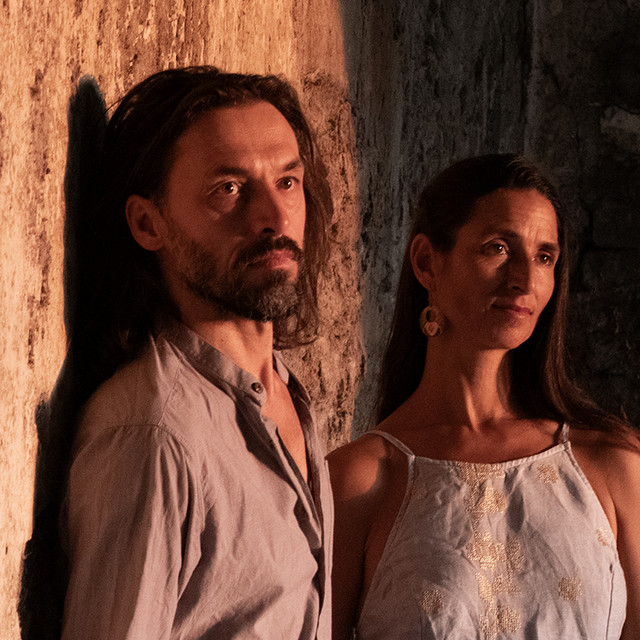
In this studio documentary, Mirabai Ceiba (the musical duo Angelika and Markus) explain the vision and creative process behind "Awakened Earth," their 2011 album dedicated to Mother Earth. The core themes include aligning as a two-person unit to transmit spiritual energy, working with producer Jamshied Sharifi in a challenging Mexican studio environment, the spontaneity of sacred moments in recording, and the use of nature-based visuals and yin-yang dance to illustrate the melting of inner walls built by society and pain.
Why Dedicate an Album to Mother Earth?
Mirabai Ceiba frames "Awakened Earth" as a "sweet dedication to our mother earth and to all its living beings." This is not a metaphorical gesture but rooted in a spiritual turning point. Angelika describes a sudden internal shift—a recognition that devotion to Earth and openness to Her presence became central to their path. "Suddenly a shift came inside of me," she explains, "and together with the decision that this is our path and this is what we decided to do to travel and with this openness I started really appreciating and feeling Mother Earth" (1:00). The album emerges from longing—what they call "the desire, the longing to the final Union with all creation"—which frames ecological reverence as a spiritual practice, not activism.
What Does It Mean to Align as a Duet in Sacred Music?
One of the most direct teachings in this talk concerns the mechanics of transmitting spiritual energy as a two-person ensemble. Angelika states: "I think to do that we have to have two people hold them like to be able to transmit something together we have to align to each other in in our Inner Space" (2:12). Alignment, crucially, is not technical synchronization. It requires each member to turn inward, connect with their own truth, and then feel themselves in the other. She elaborates: "Aligning to each other means just to connect with each other and with our truth and this no imagination is just going Inward and and feeling ourselves and then feeling ourselves in each other and how we can then share this" (2:30). This describes a non-dual moment where two separate consciousnesses meet through depth rather than surface coordination—a practice applicable to any collaborative sacred work.
How Do You Create Music in a Challenging Recording Environment?
The album was recorded at Charles Eller's Studio in San Pancho, Mexico, under the direction of producer Jamshied Sharifi. The setting was idyllic but demanding. The documentary shows the producer "working hard thinking uh thinking very deeply about the arrangements" and making complex decisions about upcoming pieces (3:00). The challenge was not technical isolation but the living environment—children playing, interruptions, the need to retreat and rest. Yet this organic, sometimes chaotic setting became part of the creative container. Rather than treating it as an obstacle, the team worked with the space's inherent energy, understanding that "it's very important not to disturb" the producer's deep thinking because "this is indeed a very very difficult and challenging environment in which to make a record" (3:20). The point is implicit: surrender to conditions rather than impose sterile control.
What Role Do Mantra and Transition Serve?
Mirabai Ceiba chose to foreground mantras and specific material "especially for the transition to the Aquarian age" (4:39). This is not new-age speculation but a deliberate sacred technology—the idea that mantra carries frequency and intention suited to collective evolutionary moments. By centering mantra in the album, they position their music as a tool for consciousness shift during a particular historical threshold. The specificity of "Aquarian age" material suggests they were working with astrological and dharmic frameworks common in Hindu and tantric traditions.
What Happens When Everything Comes Together in a Single Take?
One of the most potent moments discussed is what Angelika calls a breakthrough in the studio: "Sometimes in the studio a moment happens in all the creative process where suddenly everything comes together on this record it was a hamand where where we just sat down and we started to song and it went all the way through and then after this we didn't do any other take it was just in place" (5:14). This describes the non-linear, grace-based nature of sacred music creation. A piece that required no overdub, no correction, no second take—an embodiment of what kirtan and bhajans call *sahaj*, or effortless flow. It reflects the spiritual principle that when alignment is true and obstacles cleared, the channel opens and transmission flows whole.
How Do Nature Images and Dance Connect to Inner Spiritual Work?
The music video, titled "Written by Nature," became a key visual companion to the album. Created by dancer and filmmaker Kti over seven years, it features yin-yang dance (a partner dance style) performed by Kti and her teacher Atushi in pristine natural settings: Alaska and Hawaii. The dance style itself embodies a spiritual approach—"you can dance the spirit which lives in the things we really feel this um this Divine spark this flow of the Divine" (6:55). But the genius lies in metaphor: breaking ice in the video becomes a metaphor for melting the inner walls we build. Angelika explains: "The breaking of the ice um in the video is so much a metaphor for for this melting of the inner eyes we grow up in the society and and and sometimes we get hurt or confronted with life and relationships and work and challenges and sometimes we start just building these walls between our heart" (7:34). The outer nature—glaciers, ocean, wilderness—mirrors the inner work of dissolving the frozen defenses accumulated through living. This is a sophisticated use of the external natural world as a mirror and teacher for internal emotional-spiritual transformation.
What Is the Spiritual Function of Beauty and Aesthetics?
Throughout the discussion, Mirabai Ceiba treats beauty—the images of pristine nature, the dancers' movements, the arrangement of sound—not as decoration but as a doorway. Angelika describes the experience of uniting "this Mantra and of this poem with the pure brown nature" as itself transformative. Beauty here functions as a transmission: when the eye and heart receive pristine natural imagery paired with sacred sound, the integration opens what they call "the door of of love and light in US" (1:30). This echoes the Hindu-tantric understanding of *rasa* (aesthetic taste) as a pathway to the divine.
Where to go from here
For students of sacred music creation, this talk offers concrete insights: the need for deep inner alignment before external collaboration; the role of spontaneity and grace in artistic work; the use of natural metaphor to access and heal emotional patterns; and the role of mantra and sound as vehicles for consciousness transition. To deepen this practice, explore the actual album "Awakened Earth" with the teachings in mind—listen for how the two voices (Angelika and Markus) create a coherent field, notice moments of effortless flow, and observe how the mantras resonate with specific life circumstances. For those interested in collaborative spiritual practice, Angelika's teaching on alignment—turning inward, connecting with truth, feeling yourself in the other—can be applied to any partner work: music, meditation, healing arts, or contemplative inquiry. The metaphor of melting inner ice through exposure to natural beauty and movement offers a somatic pathway worth exploring in your own relationship to landscape and body.


